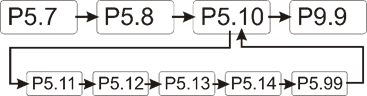
This section supplements the “LIS-SV”
product manual. The parameters described here are only available if the LIS-SV
is used in an ABULiner control unit.
Overview of the
'ABULiner' parameter level
The following parameters can be set in the 'ABULiner'
parameter level of the LIS-SV.
|

|
Danger during setting work!
During setting work on the LIS-SV, monitoring of
the wire rope hoist is switched off. This means the wire rope hoist cannot
be monitored for excess load, among other things. This means the
wire rope hoist cannot be monitored for excess load, among other
things.
This in turn means the load could fall and kill or
injure people!
Do not use the crane for normal work during
setting work, and only lift loads very carefully for test
purposes! |
All LIS-SV parameters which are important for the ABULiner
are combined in a separate parameter level, which is shown as a submenu.
 Move the load hook out of
the limit switch range (up or down).
Move the load hook out of
the limit switch range (up or down).
During parameter setting, the load hook must not be within the
limit switch range.
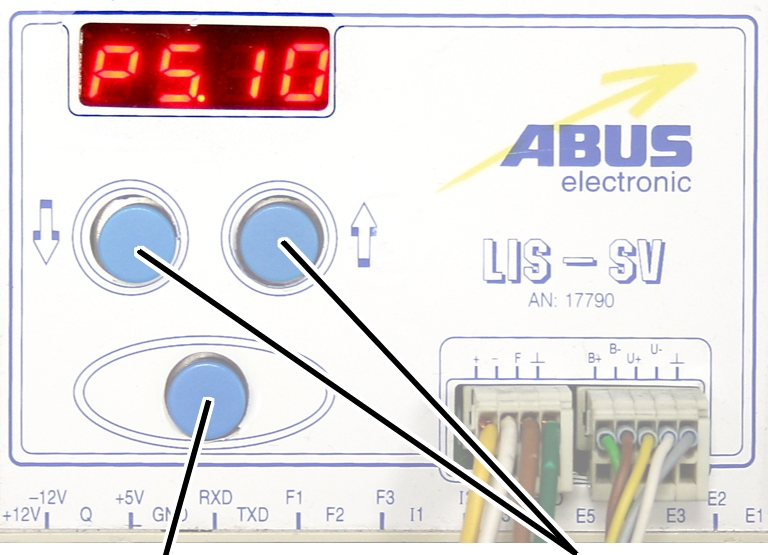
Open the menu of the
LIS-SV. See the documentation “Load indicator system LIS-SV”.
|
|
|
Enter
button |
Arrow
buttons |
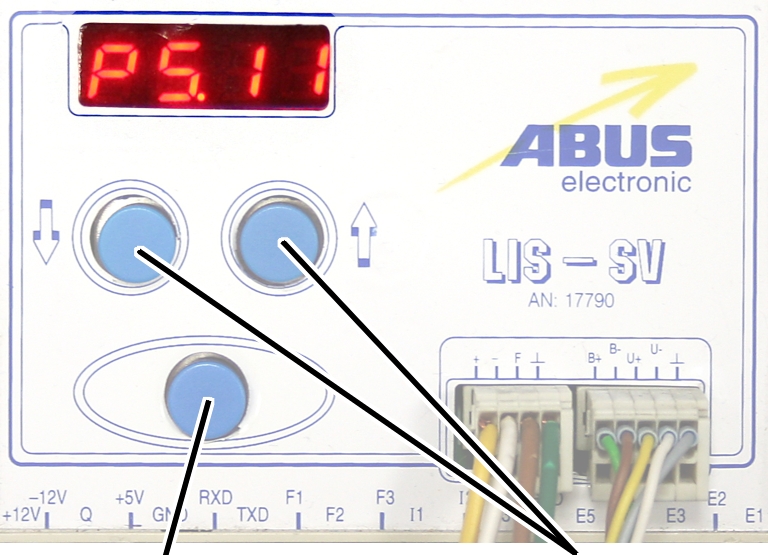
 Select parameter 5.10.
Press ENTER.
● The
'ABULiner' parameter level is activated.
● Parameter
5.11 is displayed.
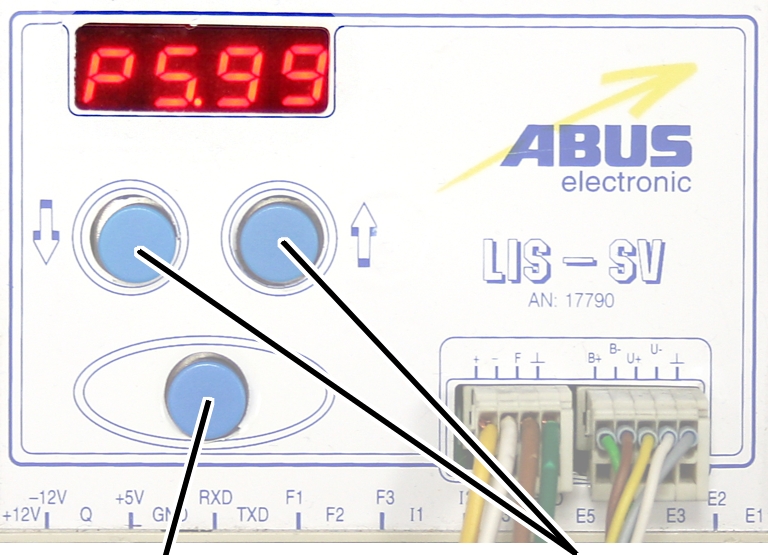
Exiting the
'ABULiner' parameter level
|
|
|
Enter
button |
Arrow
buttons |
Select parameter 5.99.
Press ENTER.
● The
previous parameter level is reactivated.
● Parameter
5.10 is displayed.
The LIS-SV is automatically activated for the ABULiner if a
value is entered for the parameter 5.11.
In the ABULiner mode (a value is set for parameter 5.11):
─ The
LIS-SV can monitor the total load for a maximum of two wire rope hoists.
─ Input F3
(normally used for measuring the load of wire rope hoist 3) now serves in
monitoring the current rotational frequency of the hoist motor.
─ A value
can be entered for parameter 3.0 (maximum load capacity of wire rope hoist 3).
If a value is entered for this, parameter 5.11 cannot be set.
─ This
interlocking thus excludes an incorrect setting.
─ The
load-controlled switching point at output TxD of the LIS-SV cannot be used.
─
Parameter 4.5 (setting for load-controlled switching point) is not available.
In the normal mode (no value is set for parameter 5.11):
─
Operation of the ABULiner Lifting/Lowering unit is not possible.
─ The
LIS-SV can monitor the total load for up to three wire rope hoists.
─ Input F3
serves in measuring the load of a third wire rope hoist.
─ A value
can be entered for parameter 5.11 (gear ratio). If a value is entered for this,
parameter 3.0 cannot be set.
─ This
interlocking thus excludes an incorrect setting.
─ The
load-controlled switching point at output TxD of the LIS-SV can be used.
─
Parameter 4.5 (setting for load-controlled switching point) can be used.
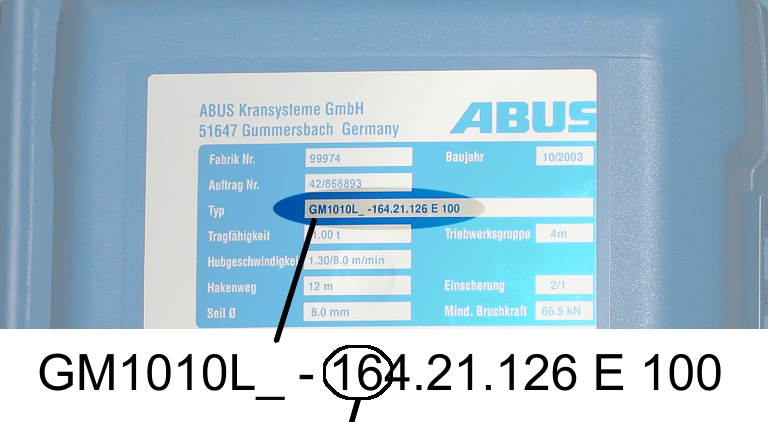
The LIS-SV uses the signal of the encoder and the gear ratio
of the hoisting gear to calculate the hook travel distance, the maximum distance
in the limit switch range and the current rotational frequency of the hoist
motor. The gear ratio must be set on the machine.
|
|
|
Cable
speed |
|
Read off the type
designation at the type plate of the wire rope hoist.
Read off the cable
speed.
From this table, select
the gear ratio that matches the cable speed.
|
|
Cable
speed |
|
Hoist motor GM |
32 m/min at 50 Hz
38 m/min at 60
Hz |
25 m/min at 50 Hz
30 m/min at 60
Hz |
20 m/min at 50 Hz
24 m/min at 60
Hz |
16 m/min at 50 Hz
19 m/min at 60
Hz |
|
800.4 |
50.01 |
63.49 |
77.77 |
98.16 |
|
800.5 |
47.03 |
60.04 |
74.66 |
95.03 |
|
1000.6 |
54.43 |
68.91 |
84.00 |
105.1 |
|
1000.7 |
54.60 |
68.06 |
81.45 |
104.6 |
|
2000.3 |
58.22 |
74.23 |
91.19 |
118.4 |
|
3000.4 |
73.61 |
93.92 |
118.4 |
152.9 |
|
5000.3 |
85.14 |
109.3 |
132.8 |
169.0 |
|
5000.4 |
80.20 |
104.9 |
127.7 |
160.6 |
|
6000.3 |
94.69 |
118.5 |
149.6 |
182.7 |
|
7000.1 |
118.0 |
148.3 |
182.6 |
232.0 |
|
|
|
|
|
|
Table: Gear ratios (numerical values) depending on
hoist motor (lines) and cable speeds (columns) at 50 and 60 Hz.
|
|
|
Enter
button |
Arrow
buttons |
Move the load hook out of
the limit switch range (up or down).
During parameter setting, the load hook must not be within the
limit switch range.
Select parameter 5.11.
Press ENTER.
● The set
value is displayed.
If the value is 0.00, the function is deactivated.
● Hold ENTER
pressed.
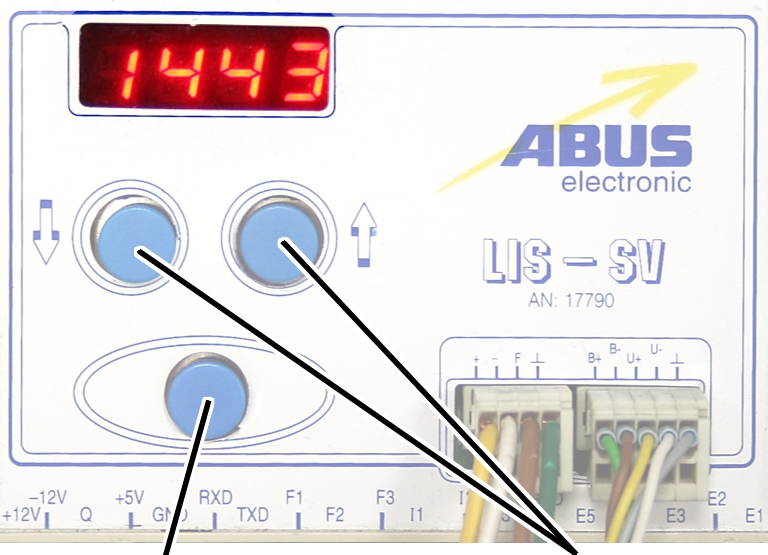
● CODE is
displayed.
Hold ENTER pressed.
|
|
|
Enter
button |
Arrow
buttons |
Enter the code 1443.
Press ENTER briefly.
|
|
|
Enter
button |
Arrow
buttons |
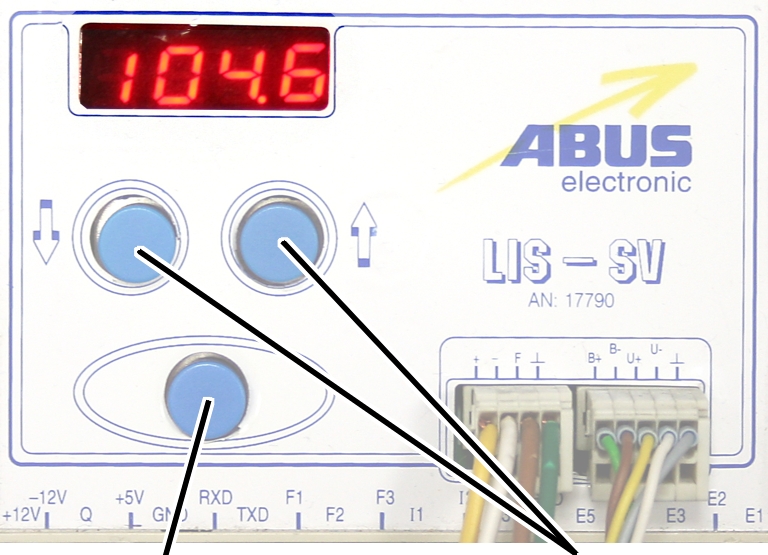
Set the value from the
table.
If the display ‘0.00’ cannot be changed, a value is set in
parameter 3.0. In this case, set the value to zero first.
Press ENTER briefly.
Elit Liga 2011 Apr 2026
The 2011 season is remembered for —goaltending so brilliant that it made boring hockey beautiful. It was the last great hurrah for the old Swedish guard: players born in the 1970s who could think the game better than they could skate it. In the history of Swedish hockey, 2011 is not the prettiest season, nor the highest scoring. But it was the final, stubborn stand of an era before the speed revolution fully took hold. It was, fittingly, a champion’s goodbye.
By 2011, Swedish hockey was in flux. The shadow of the 2006 Olympic gold medal had faded, and the "Tre Kronor" identity of patient, passing-based hockey was being challenged by the speed of the NHL. Yet, for one final winter, Elitserien belonged to the veterans. The regular season was a showcase of defensive brilliance and individual wizardry. HV71 , the defending champions, tried to maintain their grip on the crown but looked tired. Instead, it was Skellefteå AIK who emerged as the darlings of the north. Led by a young, electric forward named Joakim Lindström (who would finish as the regular season scoring leader with 60 points), Skellefteå played a speed game that felt like the future.
The quarterfinals saw chaos. crushed reigning champs HV71 4-0, signaling a changing of the guard. But the real drama was in the lower bracket. Djurgårdens IF faced Linköping HC in a series that went the full seven games. It was a goaltending duel for the ages: Wesslau vs. Christian Engstrand . Every game ended 2-1 or 3-2. Djurgården survived, but they were physically destroyed. elit liga 2011
on home ice. For the 10th time in club history, they lifted the trophy. Rickard Wallin (the captain) and Jörgen Jönsson hoisted the trophy not just as champions, but as the last representatives of a dying breed: the veteran-laden Swedish core. Why 2011 Matters Today Looking back, 2011 was a threshold. After this season, the league would rebrand to the SHL. The economic divide would grow. Skellefteå would learn from this loss and go on to dominate the next decade, winning three titles. Färjestad, however, has not won a title since.
On the other side, was doing what Färjestad always did in May: winning ugly. They swept Luleå in four tight games, with goaltender Henrik Karlsson (a massive 6’5” giant) stopping everything in sight. The Final: A Classic Clash of Styles The 2011 Le Mat Trophy final pitted Färjestad BK (Experience) against Skellefteå AIK (Youth). It was the perfect narrative: The team that had won 9 titles before facing the team that had never won one. The 2011 season is remembered for —goaltending so
However, lurking in the capital was . With the legendary Charles "Challe" Berglund behind the bench, Djurgården relied on grit and a nuclear weapon in goal: Gustaf Wesslau . Wesslau was the story of the regular season, posting a staggering 1.98 GAA and .927 save percentage. He stole games single-handedly, dragging a mediocre offensive team to a 3rd-place finish. Meanwhile, Färjestad BK , led by the ageless Jörgen Jönsson (38 years old), finished 5th, quietly plotting another deep run. The Playoffs: The Goaltending Apocalypse If the regular season was good, the 2011 playoffs were legendary for their attrition. This was the era of "low-event hockey"—every inch of ice was contested, and goals were scarcer than gold.
The series was a chess match. Skellefteå tried to skate; Färjestad tried to trap. Game 1 went to overtime. Game 2 was a 1-0 shutout. The turning point came in Game 4. With Färjestad up 2-1 in the series, Skellefteå stormed out to a 3-0 lead. But in a stunning collapse, Färjestad roared back to win 5-4 in regulation. The young Skellefteå team broke mentally. But it was the final, stubborn stand of
The 2011 Elitserien season exists as a fascinating historical artifact. It sits perched on the edge of two eras: the end of the traditional Swedish hockey dynasty and the dawn of a new, more athletic, North American-influenced style. While the playoffs concluded with a familiar champion lifting the Le Mat Trophy, the narrative of the 2011 season is not just about who won, but about what the league was losing.
Only for auxiliary fans
The auxiliary fan of the hoist motor continues to run for
several minutes after the lifting or lowering. This ensures that the hoist motor
is adequately cooled even at slow lifting speeds. The run-on time can be
adjusted.
|
|
|
Enter
button |
Arrow
buttons |
Move the load hook out of
the limit switch range (up or down).
During parameter setting, the load hook must not be within the
limit switch range.
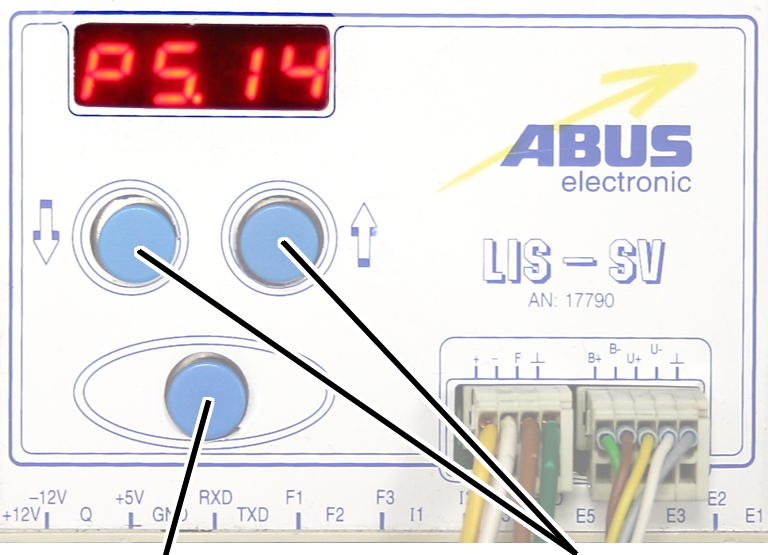
Select parameter 5.14.
Press ENTER.
● The set
value is displayed.
|
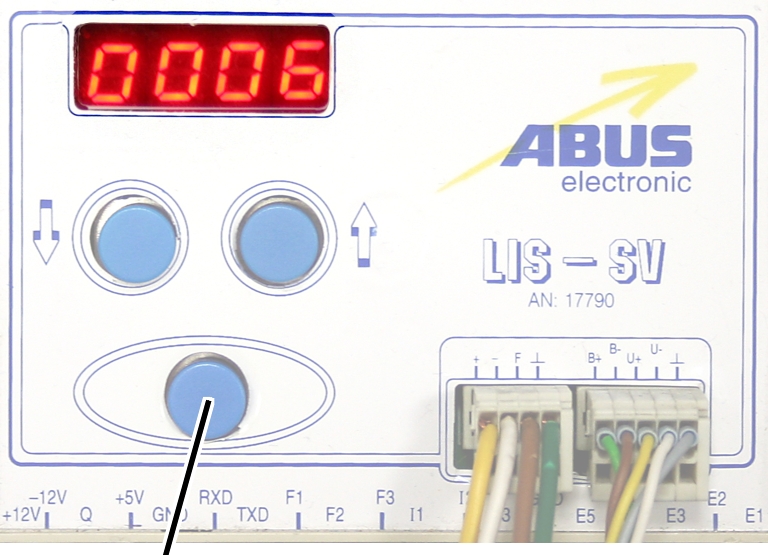
|
|
Enter
button |
|
Set the value to between 3
and 10 minutes using the arrow buttons.
Press ENTER.